
The arithmetic, and where it lies to you
The standard rule is that a kilogram of body fat holds about 7,700 calories (3,500 per pound). Divide by seven and you get the daily shortfall for one kilogram a week:
0.25 kg/week → 7,700 × 0.25 ÷ 7 ≈ 275 kcal/day
0.5  kg/week → 7,700 × 0.50 ÷ 7 ≈ 550 kcal/day
1.0  kg/week → 7,700 × 1.00 ÷ 7 ≈ 1,100 kcal/day
This is a genuinely useful approximation for the first month or two, and it is also wrong in a predictable direction. It assumes your expenditure stays fixed while your body gets smaller, which it does not. As you lose mass you burn less at rest, you carry less weight around, and adaptive changes shave off a little more. Linear predictions therefore overstate long-run loss — the Lancet modelling work below exists precisely because the 3,500 rule drifts over months.
The practical consequence: expect the first few weeks to roughly match the prediction, and expect to need a recalculation once you are five percent lighter.
Bigger is not better
The temptation is to pick the most aggressive rate and get it over with. Two things argue against it. First, larger deficits cost more lean tissue alongside fat, particularly without adequate protein and resistance training. Second, and more decisively, they are harder to sustain — and a 300-calorie deficit you keep for six months beats an 800-calorie deficit you abandon in three weeks. The arithmetic of adherence dominates the arithmetic of energy.
Making the deficit survive contact with real food
A deficit fails in the gap between the number and the plate. Under-logging is near-universal: cooking oil, the handful from a colleague’s desk, the difference between the restaurant portion and the database entry. None of it feels like eating, and all of it counts.
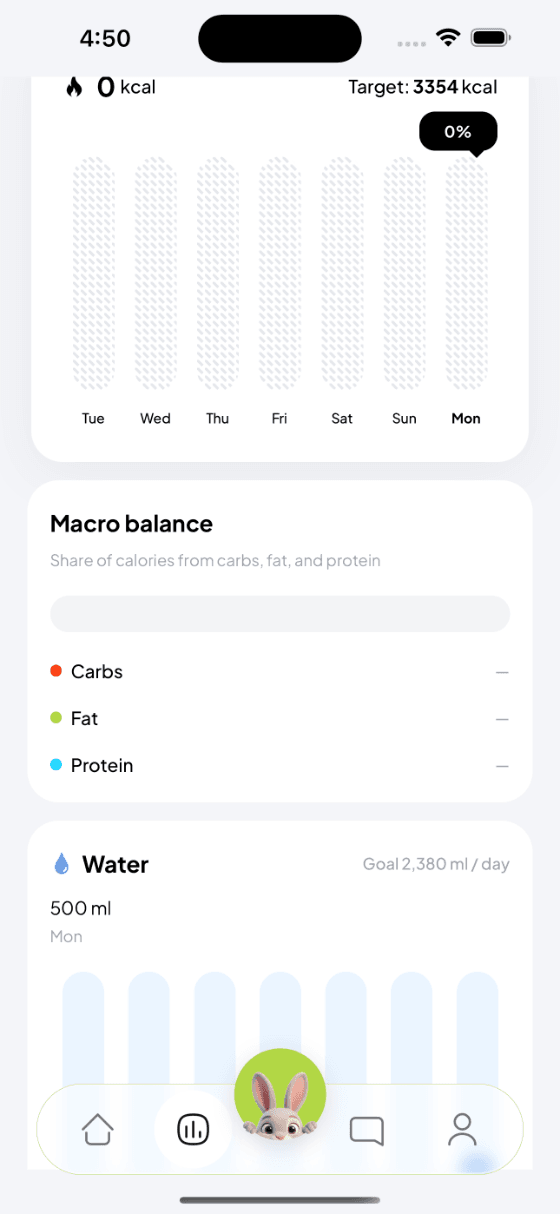
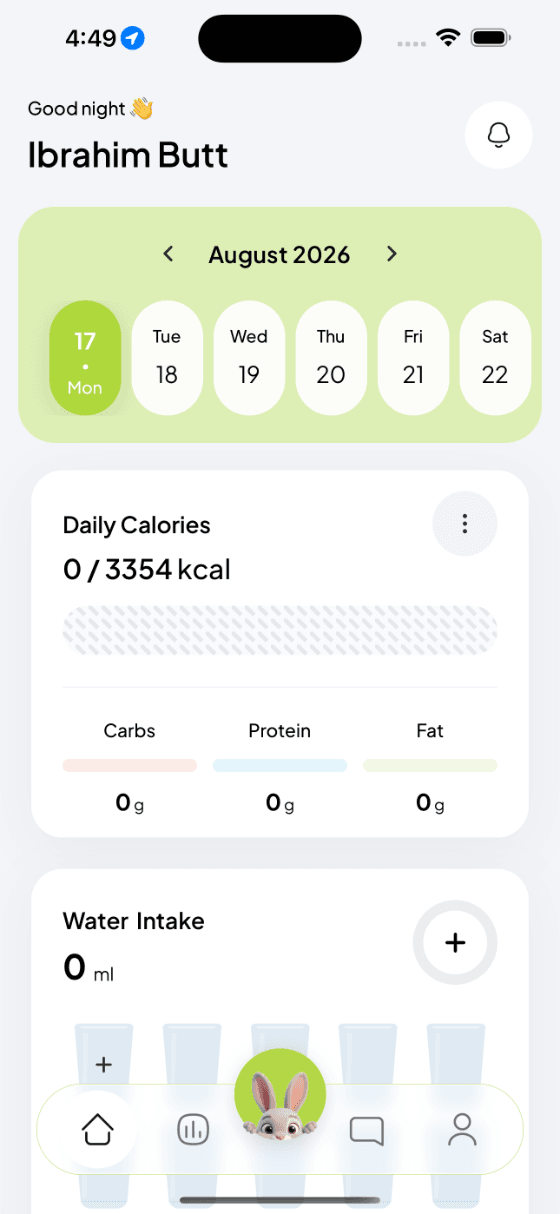
That is the practical argument for photographing meals rather than searching for them — not that a photo is more precise than a food scale, but that it is fast enough that you keep doing it. Calybite, the AI food-tracking app, names the components, estimates the portions and shows you the result to confirm before anything is saved.
Two cheap wins while you are at it: swapping sweetened drinks for water removes real calories, and water itself has none — so it never eats into the deficit.
Worth reading next: set a protein target — protein is the macro that most affects how much of your loss is fat rather than muscle. Or check find your maintenance calories if you want the number this deficit is subtracted from.
Sources
- Hall KD, et al. “Quantification of the effect of energy imbalance on bodyweight.” The Lancet, 2011.
- Wishnofsky M. “Caloric equivalents of gained or lost weight.” Am J Clin Nutr, 1958.
- Helms ER, et al. “Evidence-based recommendations for natural bodybuilding contest preparation: nutrition and supplementation.” J Int Soc Sports Nutr, 2014 — on deficit size, protein and lean mass retention.